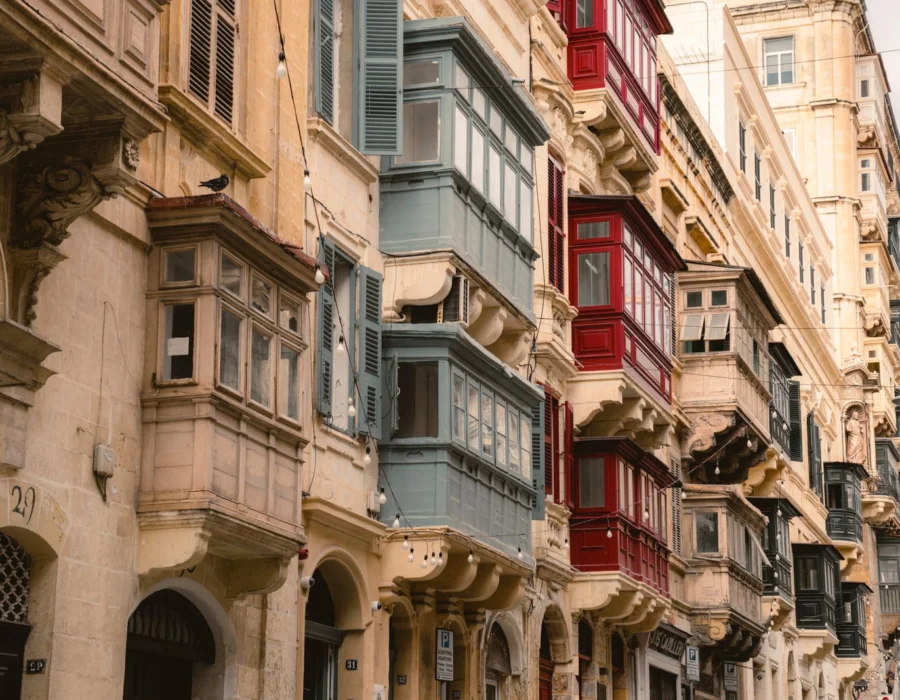
Most people photograph the closed wooden balcony in Malta without knowing what it is called. It is a gallarija.
They are on streets all over both islands, painted in strong greens, reds, blues and yellows.
What it is
It is a timber box built out from the front wall of a house at first floor level. It has windows on three sides and a solid panelled base. It is enclosed, so it works as a small extra room rather than as a platform to stand on.
Nobody agrees where it came from
One explanation traces it to the Arab mashrabiya, a screened projecting window that let people inside see the street without being seen from it. Another puts it down to Spanish and Sicilian building habits arriving later.
Both are plausible and the evidence does not settle it. The oldest examples in Malta that can be dated are the corner balconies on the Grandmaster’s Palace in Valletta, from the late 1600s. Everything before that is argument.
What it is for
It catches the breeze from three directions, which matters in August. It gives shade to the room behind it.
It lets you see up and down a narrow street where a flat window shows you only the wall opposite. And it adds floor space to a house that cannot expand sideways.
Wood and aluminium
The traditional ones are timber and need painting every few years. A lot of newer balconies are aluminium made to the same shape, because they last longer and cost less to keep. From street level the difference is easy to see once you look for the joints.
In protected areas the timber ones cannot simply be replaced with metal, which is why the older streets still look consistent.
Where the best ones are
Valletta has the highest concentration, and the streets running downhill towards the harbour show whole terraces of them at once. Birgu, Senglea and the older village cores are the other places to look.