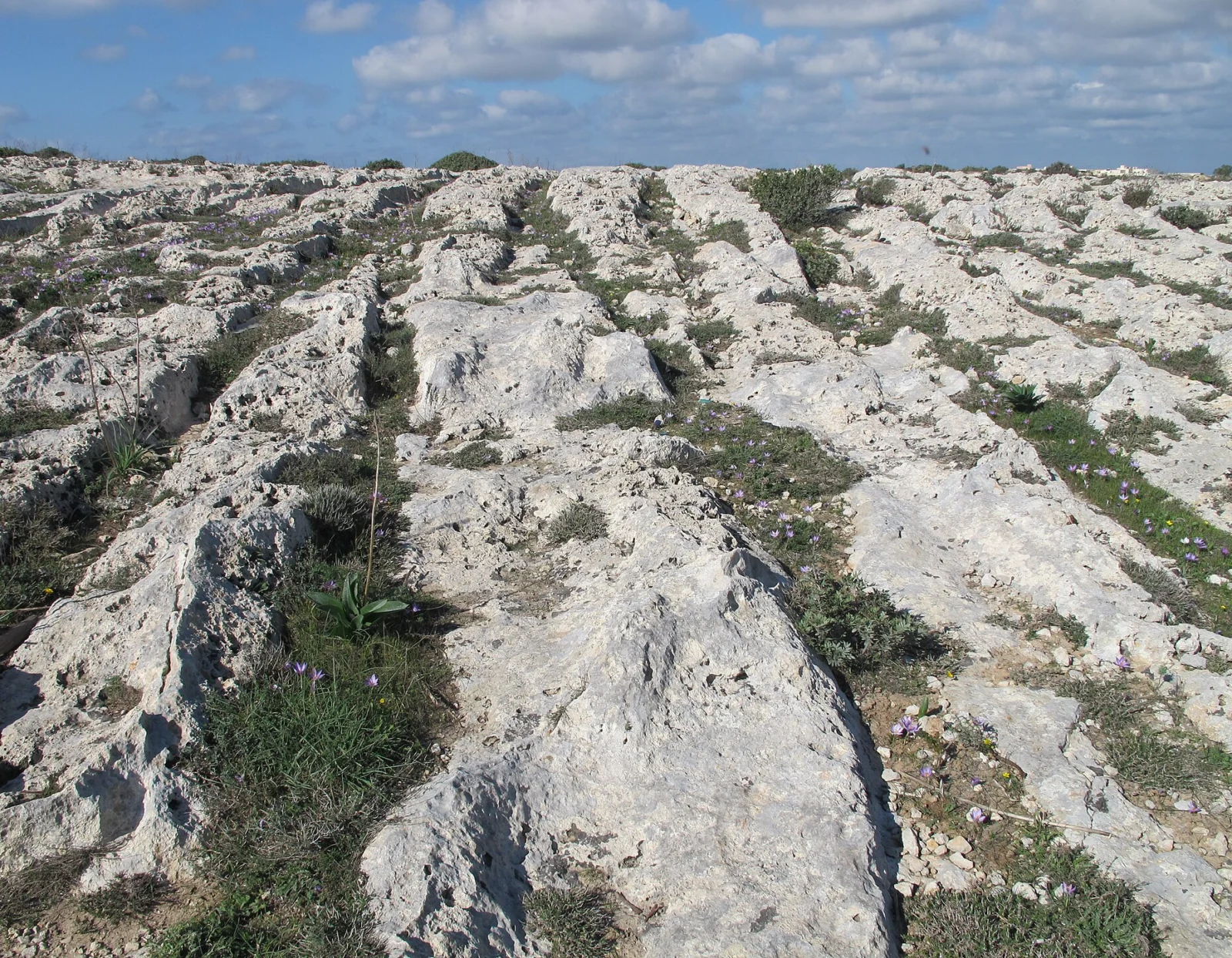
There are pairs of grooves cut into the bare limestone all over Malta and Gozo.
They run for hundreds of metres, they cross each other, and some go straight over a cliff edge.
Nobody has settled what made them.
Where to see the cart ruts
The best site is Misraħ Għar il-Kbir, on high ground between Siġġiewi and Dingli.
It is nicknamed Clapham Junction, because the grooves converge and cross like railway points.
It is open ground, it is free, and most days there is nobody there.
Wear proper shoes. The rock is uneven and the ruts themselves are ankle deep in places.
There are more sets at San Pawl tat-Tarġa near Naxxar and at Ta’ Ċenĭ in Gozo, though Clapham Junction is the one worth the drive.
What they are not
They are not wheel ruts in the ordinary sense.
The pairs keep a steady distance apart, but the grooves are U-shaped and deepen rather than widen.
A wheel wears soft rock the other way round, cutting a wider, flatter channel as it goes.
Depths run from a few centimetres to about 60cm at the deepest, and the gauge between a pair is usually around 1.4 metres.
The theories
The common one is that loads were dragged on a sledge or a two-pole cart, and the poles wore the rock down over generations.
Others have suggested quarry transport, or channels cut deliberately to carry water.
None of them explains every site. The ones that cross each other at odd angles are the hardest to account for.
The dating is loose as well. Most estimates put them in the Bronze Age, well after the temples.
The rock carries no material to date directly, which is why the range stays wide.
The ones that run into the sea
A few sets disappear over cliffs or continue underwater off the coast.
That is usually read as the coastline having changed since they were cut, rather than as anything stranger.
Sea levels here have risen since the Bronze Age, and parts of the shoreline have collapsed outright.
Visiting Clapham Junction
There is no ticket office, no fence and no signage worth the name. Park on the road and walk in.
Go in the morning or late afternoon. Low sun throws the grooves into relief and they are hard to read at midday.
Nearby are the Dingli Cliffs, a set of Punic tombs, and a small troglodytic cave settlement in the same field system.
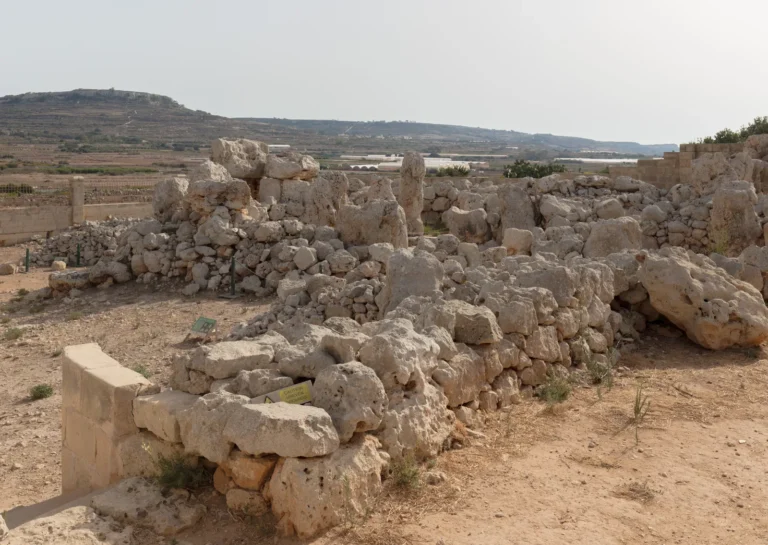
If you came for prehistoric Malta, the temples and the Hypogeum are the other half of it.