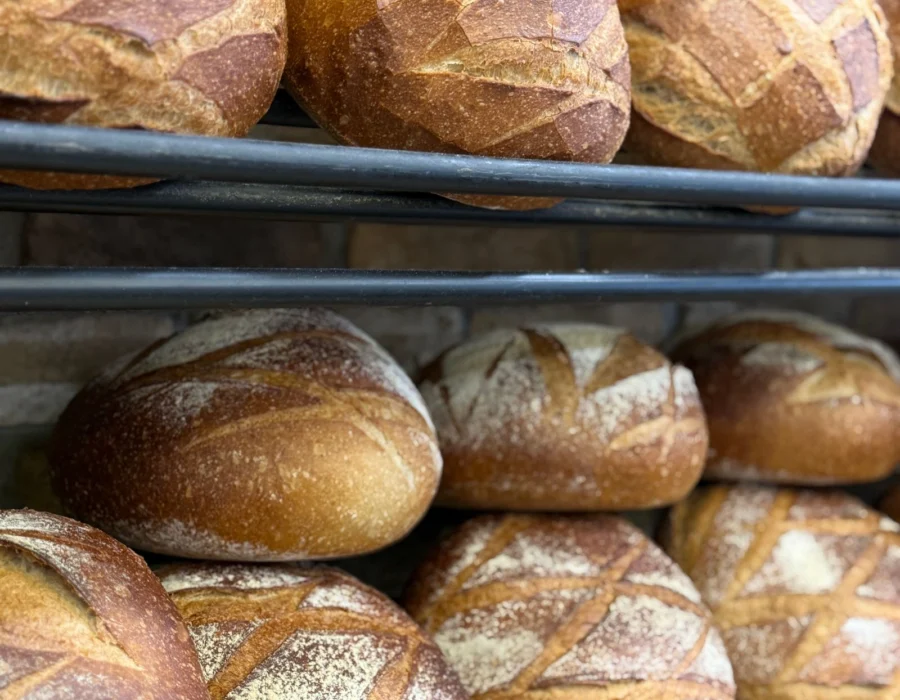
Maltese bread has a thick, dark, blistered crust and a soft open crumb inside. It goes stale in a day.
Both of those come from how it is made.
The sourdough starter
Ħobż tal-Malti is raised with a sourdough starter kept going from batch to batch, not with commercial yeast.
That is where the faint sourness comes from. It is also why the loaf holds its shape without much help and why the crumb has large irregular holes.
Some bakeries have kept the same starter running for decades.
Baked hard, in a very hot oven
Village bakeries still use stone ovens and some are wood fired.
The heat is fierce and the loaves come out with a crust that crackles when you press it. A pale, soft loaf is not the real thing.
The dark blisters on the crust are scorch marks from the oven floor, not a fault.
Eat it the same day
There is nothing in it to keep it soft. No fat, no milk, no preservative.
Buy it in the morning and eat it by the evening. By day two it is hard.
Nothing gets thrown away. Day-old bread goes into soup, or gets rubbed with tomato and oil.
Ħobż biż-żejt
The national snack, and the main thing yesterday’s loaf becomes.
A thick slice is rubbed with ripe tomato, soaked in olive oil, then loaded with tuna, capers, olives, onion and sometimes ġbejniet.
It is sold at kiosks and village bars for a few euro and it is a meal, not a snack.
Where to buy it
Any village bakery, early. The good loaves go before mid-morning.
Some bakeries still deliver by van and you will hear the horn in the street. If you are staying in a village, ask a neighbour what time it comes.
Supermarket loaves labelled Maltese bread are usually a softer imitation with a paler crust.
Ftira, the other loaf
Ftira is the flat ring-shaped version of the same dough. It is the one used for sandwiches.
Maltese bread-making was added to UNESCO’s intangible cultural heritage list in 2020, ftira included.